A field report on the arithmetic that decides whether a girl keeps showing up — early marriage, unpaid domestic labor, menstrual health barriers, and the walk to school itself. Illustrative composite, drawn from patterns across Compass program sites.

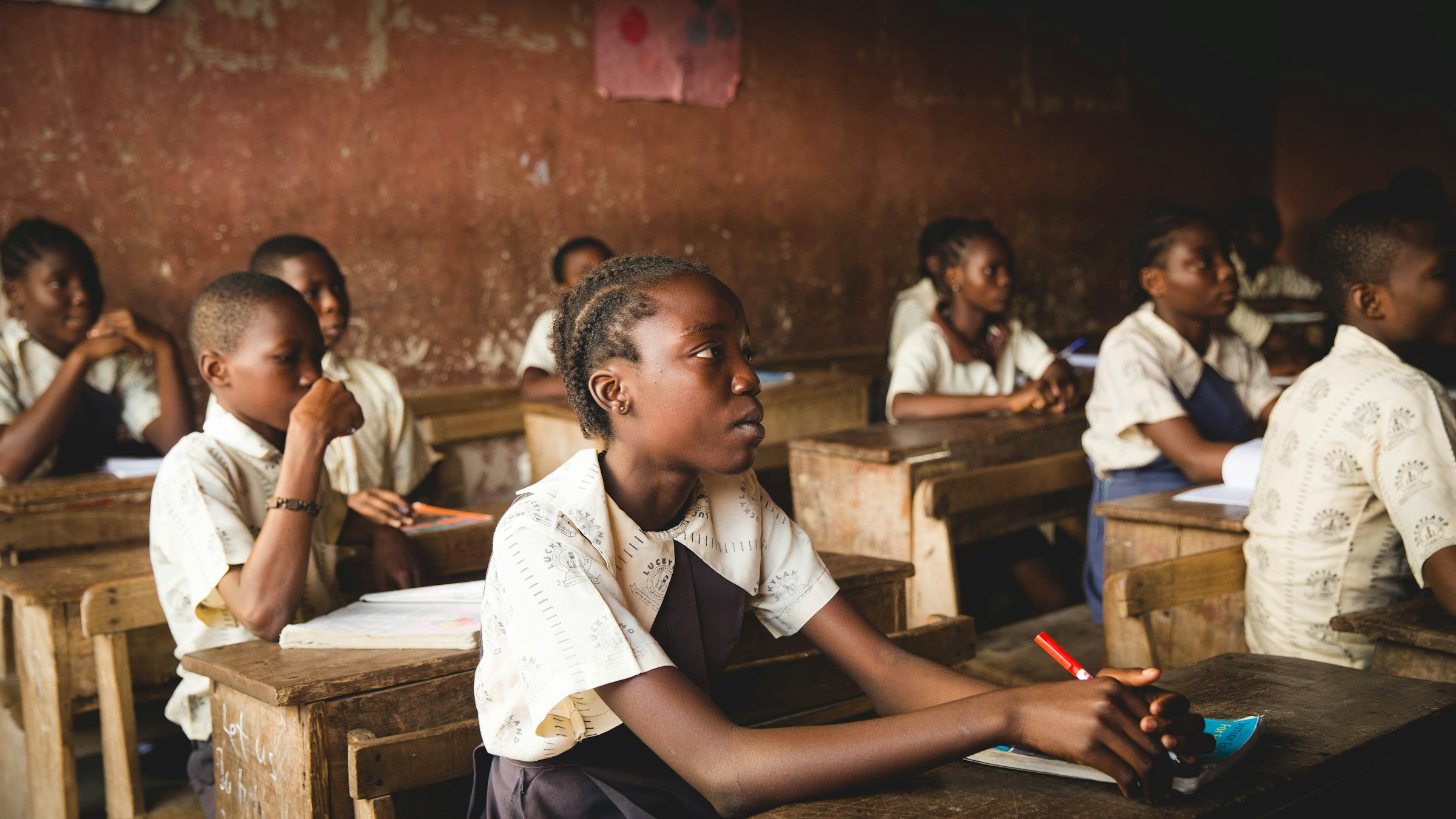
Amina is twelve, and this Tuesday she is not at her desk. She is at the borehole before six, then behind her mother's stall until the market thins out, and by the time the closing register is called at her primary school she has already worked a longer day than most people reading this sentence will put in this week. Nobody decided she should drop out. It is simply that today, again, school lost.
This is a report about that quiet arithmetic — and the unglamorous system built to tip it back in her favor.
Amina is not one person. She is assembled from recurring patterns across program caseloads in the communities Compass serves — the names, schools, and specifics here are constructed for this report and do not describe an identifiable individual.
Amina missed Tuesday and Wednesday. Auntie at the stall said she was "helping at home." Flagged the absence in Compass Field before I'd even reached the compound — the teacher had already logged it, same day. Used to hear about these two weeks late, if at all.
Talked to her mother properly this time, not at the doorway. It isn't attitude — it's market days and a baby sister with no one else to mind her. Logged a household-labor risk flag, referred to the small grant fund for a half-day helper.
A suitor's family visited over the weekend. Amina is twelve. Raised it to the programme director same day through Compass — this is the flag that has to move fastest, and now it does.
Full attendance, three weeks running. The stipend covered the helper for six weeks; the conversation with her mother did the rest. Closing the early-marriage flag as resolved. Leaving the attendance one open — habits are more fragile than they look.
For girls in the communities Compass serves, distance to school is also a question of safety on the walk there. A longer route, taken alone, is a reason a parent quietly keeps a daughter home on a bad day — and bad days add up.
Without reliable access to sanitary products or a private facility at school, menstruation alone can cost a girl several days a month. Multiply that across a school year and the absence looks, on paper, like disengagement.
Domestic labor isn't scheduled around the school day — market days, younger siblings, and household chores are. A girl is often the flexible line item in a family's unpaid workload, and school is what flexes first.
Economic pressure on a household can make an early marriage proposal look, however painfully, like a rational choice. It rarely arrives as a single conversation — it arrives as a pattern a caseworker learns to watch for.
None of these pressures are decided by a girl alone. They're negotiated in kitchens, at community meetings, between a mother and an aunt — which is exactly where a caseworker's early flag can still change the outcome.
Not a rollout plan — a school calendar. The same case file follows Amina from the day she re-enrolls to the day her Term 3 outcome informs whether she comes back for Term 1 again.
Field data entered once, on a tablet at the school gate, is the same data the programme director reads that evening.
Where Amina's file starts: enrollment, household baseline, and the risk factors that matter on day one.
The app Ngozi actually opens between compounds — attendance, flags, and notes that reach the office same-day.
Small, trackable support — a helper's wage, a uniform, a sanitary-kit stipend — tied to the flag that triggered it.
The shared record beneath all of it: one girl, one file, no re-typing her story into five systems.
Pattern-spotting across hundreds of Aminas — surfacing which flags, in which communities, actually predict dropout.
Term-by-term retention, disaggregated by risk factor, ready before the donor report is due.
Composite perspectives, drawn from recurring patterns raised across girls'-education programme conversations — not verbatim quotes from a named organisation.
I used to find out a girl had dropped out at the end-of-term count. Now I see the flag the week it starts — while there's still a term left to save.
My case notes used to live in a notebook that only I could read. Now Ngozi's entries and mine sit in the same file, and neither of us starts a visit from zero.
Term reports used to take a week of reconstructing spreadsheets. Now retention by risk category is a filter, not a project.
What mattered to us was data residency and a clean export to our EMIS. Compass didn't ask us to abandon our existing systems — it sits on top of them.
I used to think if I missed enough school, no one would notice. Now someone always does — and they come with a reason to keep me here, not just a warning.
Attributed to the composite figure introduced on the Cold Open page. No individual pupil record is represented or referenced.
Compass Intake and Field, live in the schools you choose, configured to your existing enrollment forms.
Existing rosters and case notes imported and deduplicated — no re-keying a term of history.
Term-by-term retention by risk category, exportable to your EMIS and donor templates from week one.